Anaphylaxis, “Answers”

1. How do you define anaphylaxis?  When and how do you give a patient with anaphylaxis epinephrine? How does age or past medical history factor in your decision?

Anaphylaxis is an allergic reaction, with rapid onset after contact with the offending allergen, which may cause death.  In short, the criteria for this clinical diagnosis are acute onset of skin/mucosal involvement (seen in 80-90% of patients, not all) with respiratory compromise and/or reduced blood pressure (Sampson, 2006).

There are basically no modern, placebo-controlled, randomized trials for any therapies we use for humans experiencing anaphylaxis. This is in part because of the life-threatening nature of the disease, the sense from case series and clinical practice that epinephrine works, and the difficulty of obtaining consent from a hypotensive patient in respiratory distress who is also vomiting (Sheikh, 2009).

Patients with anaphylaxis should get epinephrine now, not later. Cases series of 13, and 124, respectively, fatal and near fatal anaphylactic reactions (Sampson, 1992; Bock, 2001) showed that patients who received epinephrine within thirty minutes of symptoms were more likely to live, and that of patients who died, very few received any epinephrine during their treatment.

The method of administering epi is clear: intramuscular injection into the antero-lateral thigh. Studies in children and adults not experiencing anaphylaxis (n.b.) have shown a more rapid increase in plasma and tissue epi levels with this mode, even over IM deltoid injection (Simons 2001; Simons, 1998).

There are NO absolute contraindications to the use of epinephrine in anaphylaxis. Many practitioners are concerned about side effects of administering epi in the elderly, especially those with CAD or cardiac risk factors. Remember, however, that the heart is a target in anaphylaxis itself, which can worsen CAD, can cause MI, or cause dysrhythmia. Most experts feel this cardiac risk from untreated anaphylaxis, coupled with the risk or death or other serious illness from anaphylaxis, mean that epinephrine’s benefits outweigh this theoretical risk, and give it in such a situation (Sheikh, 2009).

2. When do you consult ENT to scope a patient with an allergic reaction/anaphylaxis?

The literature does not really address this question. Our practice is that ENT should be called early when there is any question of airway involvement, obviously with stridor, uvular or other apparent airway edema, voice changes, and so on.  However, the time course of anaphylaxis is such that by the time a consultant arrives with their scope the situation may have progressed to where you are sweating and looking at the cric kit.  All of this is to say:  call ENT early, as their visualization of the cords when airway involvement is equivocal is of utility, as are serial viewings to see edema resolving.  In the scenario of progression, especially after IM epi, however, please proceed to question three.

3. How do you make the decision to intubate a patient with anaphylaxis?

In a word, early. If you’ve never seen severe and progressive anaphylaxis, please believe us when we say you should always have a difficult airway box at the bedside and ready whenever anyone with even a hint of respiratory involvement comes to you. Over seconds to minutes, patients can go from phonating with slight voice change to complete occlusion of the upper airway with severe bronchospasm.  Be ready to cric or perform a trach, emergently.   Also, in cases such as these, when patients are not responsive to IM epi, an epinephrine drip is indicated.  Although this is slightly beyond the purview of this EM Lyceum topic, we like this video for how to make your own epi drip (in a pinch).

4. Which patients do you admit?  How long do you observe the patients you intend to discharge?

Any patient with refractory anaphylaxis or who required respiratory intervention should be admitted, without passing go, to the ICU.  For the majority of patients, though, the disposition question is one of observation time. Other factors in determining disposition are the feasibility of getting an Epi-pen at the time of discharge (e.g., pharmacy access in the middle of the night), ease of returning to the ED if there is a recurrence of symptoms, and history of biphasic anaphylaxis.

Biphasic reactions are a common concern, wherein the symptoms recur after the initial medications have worn off, or due to a second wave of immune response to an allergen. This phenomenon has been described from 1 hour to 3 days after initial exposure to the allergen (Douglas, 1994), a fact that must be communicated to patients discharged to home. From case series, it is theorized that biphasic anaphylaxis occurs in 1-20% of all cases, and that it is closer to 20% in the more severe cases, especially those requiring higher doses of epi. The expert consensus on anaphylaxis, and the practice of most physicians in our departments, is to observe patients who are symptom free for a period of 4-6 hours in the department (but of course warn them, on discharge, of the possibility of a delayed biphasic recurrence) (Sampson, 2006; Tole, 2007; Kemp, 2008).

Posted in Uncategorized | Tagged , , | 2 Comments

Anaphylaxis, Questions

1. How do you define anaphylaxis?  When and how do you give a patient with anaphylaxis epinephrine? How does age or past medical history factor in your decision?

2. When do you consult ENT to scope a patient with an allergic reaction/anaphylaxis?

3. How do you make the decision to intubate a patient with anaphylaxis?

4. Which patients do you admit?  How long do you observe the patients you intend to discharge?

Posted in Uncategorized | 1 Comment

Sickle Cell Disease, “Answers”

 1.)    How do you determine whether or not a sickle cell patient is currently experiencing an acute pain crisis? 

Acute pain crises are one of the most common reasons patients with sickle cell disease (SCD) seek medical attention in the emergency department.  The most common locations SCD patients complain of pain in acute crises are the upper back (63%), left arm (61%), legs (38%), and chest (26%). Episodes can last from 2-7 days (Wilkie, 2010).

The problem, unfortunately, is the widespread belief that exists among  physicians and nurses that opioid addiction and abuse runs rampant within this population.  In a survey of 286 physicians at academic hospitals throughout the US, over 80% of physicians felt that self-reporting was not the most reliable indicator of pain in this patient population (Labbe, 2005).  This often places the emergency physician in a false conundrum: How do I know that my patient is truly experiencing an acute pain crisis versus seeking opioids to feed an addiction?

Some physicians may incorrectly use vital sign abnormalities to attempt to identify the presence of an acute pain crisis; however, no correlation between the two actually exists.  One single-center, retrospective review of 459 SCD patients with acute pain crises found no episodes of hypertension associated with an acute pain crisis (Ernst, 2000).  Another study examining the use of ketoprofen in acute pain crises looked at 66 patient episodes and only found one that included tachycardia (Bartolucci, 2009).

In terms of laboratory data, there is also no correlation with hemoglobin level/reticulocyte count and the presence of an acute pain crisis.  Patients often experience acute pain crises without any drop in their hemoglobin level.  Many large interventional trials among SCD patients report hemoglobin concentrations between 8-10mg/dL in patients experiencing acute pain crises, a level that is similar to the baseline in this patient population (Ballas, 2004 & Bartolucci, 2009).  In fact, there is some evidence to suggest that a lower hemoglobin level portends lower rates of acute pain crises because of lower blood viscosity (Bouchair, 2000).

The bottom line is that there is no combination of clinical or laboratory data that can assist a clinician in determining whether or not a patient is experiencing an acute pain crisis.  Unless there is evidence that a patient does not have SCD, take a patient’s complaint seriously and provide them adequate medication to relieve their pain.

2.)    How do you differentiate an acute pain crisis from pulmonary embolus or acute chest syndrome (ACS)?

In patients with SCD presenting to the emergency department with chest pain, it is important to consider non-SCD-related conditions, such as pulmonary embolus, before attributing pain to SCD.  In SCD patients, the incidence of pulmonary embolism secondary to deep venous thromboembolism (DVT) is similar to non-SCD patients matched by age, sex, and race.  Difficulties arise, however, in diagnosing a PE in patients with SCD as there is often a lack of evidence for DVT and their ventilation-perfusion scans are often abnormal at baseline.  Furthermore, the use of hypertonic intravenous contrast agents commonly used in CT angiography may be unsafe, as it can induce further intravascular sickling and worsen renal insufficiency. Unfortunately, there is little evidence in the literature on how to differentiate between these two diagnoses, beyond that which exists for diagnosing PE in the general population.

It is also vital to consider the diagnosis of acute chest syndrome (ACS) in patients with SCD presenting with acute chest pain, as it is the most frequently reported cause of death in these patients. According to guidelines on sickle cell disease management written by the NIH/National Heart, Lung, and Blood Institute in 2002, the diagnosis is made if a patient with SCD presents with at least two of the following signs/symptoms:

  • Chest pain
  • Fever > 38.5 C (101.3 F)
  • New pulmonary infiltrate on chest x-ray
  • Respiratory symptoms (coughing, wheezing, or shortness of breath)
  • Hypoxemia

Therefore, the evaluation of chest pain in patients with SCD should always include a chest x-ray.  ACS is caused either by infection (especially Chlamydophila pneumonia and Mycoplasma pneumonia), pulmonary infarction from in-situ thrombosis, or fat embolism.  ACS may lead to rapid deterioration in pulmonary status; patients often require ICU-level care.  The cornerstone of treatment resides in administering antibiotics as well as exchange transfusions to increase Hemoglobin A levels to > 70% (NIH/NHLBI, 2002).  

3.)    What do you do for patients once you’ve decided this is an acute pain crisis?  Which lab values are helpful?  Do you provide oxygen and fluids to all your patients in pain crisis? 

Although laboratory data may not assist you in determining whether or not a patient is having an acute pain crisis, they can help you assess the severity of a patient’s disease state as well as identify other emergency states in the sickle cell patient.  As discussed, sickle cell patients maintain a baseline hemoglobin level of approximately 7-10mg/dL and a compensatory reticulocytosis between 5-10%.  An acute drop in their hemoglobin level below their normal baseline may be the first indication of a splenic sequestration crisis (seen in children, primarily), transient red cell aplasia (caused by Parvovirus B19), or hyperhemolytic crisis.  A low reticulocyte count (<1%) may further help pinpoint a transient red cell aplasia, whereas elevated LDH, elevated indirect bilirubin, and decreased haptoglobin levels may be markers for hyperhemolytic crises.

The administration of oxygen to sickle cell patients with acute pain crises is often a reflex we perform upon their arrival in the emergency department.  Some small studies and case reports, however, do demonstrate that giving prolonged supplemental oxygen to non-hypoxic patients with SCD can reduce circulating erythropoietin levels in the body and cause marrow hypoplasia (Embury, 1984 & Lane, 1988).  As a result of these studies, many sickle cell experts recommend providing supplemental oxygen either intermittently or to hypoxic patients only.

In terms of fluids, studies have shown reduced sickling when hypotonic fluids are administered (Clark, 1980). Older evidence also demonstrates an association between excess fluid and atelectasis, a risk factor for acute chest syndrome.  As a result, some clinicians advocate D5 ½ normal saline at a maintenance rate instead of IV fluid boluses of normal saline for all euvolemic patients with sickle cell-related pathologies.

4.)    Which pain medications do you use in patients experiencing an acute pain crisis?

Treatment of pain crises in patients with SCD in the emergency department is primarily accomplished through the use of opiates.  The IV route is preferred due to its predictable pharmacokinetics, but oral and subcutaneous routes may be acceptable if IV access is not available.  Morphine, hydromorphone (dilaudid), and fentanyl are all options for pain control.

The NIH recommends administering opiates by IV push every 15 minutes until a patient’s pain score is reduced by 2 on the “1-10 pain scale” (NIH/NHLBI, 2002). Some studies have shown decreased length of stay in the ED and shorter time to pain relief by using a PCA pump as opposed to bolus doses of opiates (Gonzalez, 1991).  Therefore, if available, consider using a PCA pump even if you suspect the patient will not require admission.

The long-term effects of NSAIDS in patients with SCD are not well-studied.  As some studies show they may be associated with renal injury, especially in children, avoid them.  Similarly, if your department still stocks meperidine, it should be avoided in SCD patients: it is renally cleared, making it unsuitable in a patient population with almost universal renal abnormalities as a result of microvascular infarction (even with normal creatinines).

Both ketamine and magnesium are currently being studied as possible adjunct treatments for patients with acute pain crises.  Low dose ketamine infusions in children may improve pain control and decreased the amount of opioid needed in a pain crisis (Zempsky, 2010).  Magnesium may be associated with a decreased length of stay in patients admitted for acute pain crises.  Further studies are underway to fully evaluate magnesium and ketamine’s incorporation into the management of patients with acute pain crises.   

5.)    Which patients do you admit?  For discharged patients, what is the discharge plan? 

Generally speaking, patients with intractable pain that is not controlled in the emergency department require admission.  The question arises as to what is considered “intractable.”  Some physicians use a cut-off of three IV bolus administrations after which patients are admitted, however no rule can be applied to all patients.  The decision for admission is usually a combined decision between the physician and the patient to evaluate the best method of achieving adequate pain control.

Patients can be discharged home as long as their pain can be controlled by oral medications.  As discussed earlier, pain crises may last between 2-7 days.  Therefore, it is important to inform patients to return to the emergency room if their pain returns to an intolerable level.  Patients should be instructed to avoid situations that may induce pain crises, like cold and dehydration, and to follow-up with their hematologist in the outpatient setting within 2 weeks of discharge.


Posted in Uncategorized | Tagged | Leave a comment

Sickle Cell Disease, Questions

1.)    How do you determine whether or not a sickle cell patient is currently experiencing an acute pain crisis? 

2.)    How do you differentiate an acute pain crisis from pulmonary embolus or acute chest syndrome (ACS)?

3.)    What do you do for patients once you’ve decided this is an acute pain crisis?  What lab values are helpful?  Do you provide oxygen and fluids to all your patients in pain crisis?

4.)    Which pain medications do you use in patients experiencing an acute pain crisis?

5.)    Which patients do you admit?  For discharged patients, what is the discharge plan?

SCD Questions Poster

Posted in Uncategorized | Tagged | Leave a comment

RSI Episode 2: Induction, “Answers”

1. Describe what an induction agent is and what the optimal characteristics   are for an induction agent to be used in RSI.

Ron Walls states that the optimal induction agent “would smoothly and quickly render the patient unconscious, unresponsive and amnestic in one arm/heart/brain circulation time.  Such an agent would also provide analgesia, maintain stable cerebral perfusion pressure and cardiovascular hemodynamics, be immediately reversible, and have few, if any, side effects.  Unfortunately, such an induction agent does not exist.”


2. What are the advantages and disadvantages of the following induction agents: etomidate, ketamine, propofol and midazolam? Do any of these agents have relative/absolute contraindications? 

Etomidate: Pro: hemodynamically stable, rapid on, rapid off.  Con: no analgesia, no reversal agent.  Debatable downside in sepsis (see question #3 below).

Ketamine: Pro: hemodynamically stable (may actually increase BP and HR), rapid on, rapid off, analgesic agent.  Con: No reversal agent.  May not be advisable for older patients (especially those with known cardiovascular disease). Historically, ketamine was thought to be bad for induction in head trauma due to an increase in ICP, but recent literature shows that it does not appear to increase ICP, and suggests it may actually be neuroprotective (Filanovsky, 2010).

Propofol: Pro: rapid on/off, anti-epileptic properties. Con: hemodynamically unstable, no reversal agent.

Midazolam: Pro: rapid onset of action, anti-epileptic properties. Con: can be a hemodynamically unstable agent at induction doses (0.3 mg/kg).

3. Why may etomidate be a poor choice in RSI for septic shock?  What          evidence exists for this potential contraindication? 

Etomidate causes transient (up to 48 hours) of adrenal axis suppression with single dose use, leading to decreased response to exogenous cosynotropin stimulation testing. A raging debate has surrounded its use in RSI in patients with sepsis for this reason, and due to studies showing worse outcomes in patients sedated in an ICU setting with etomidate infusions. However, there has never been a study that was adequately powered, randomized, etc., that showed a mortality or morbidity change with single dose etomidate for RSI. A recent study by Tekwani, et al., 2009, showed no significant difference in hospital length of stay or mortality between patients randomized to RSI with etomidate versus midazolam.  Etomidate is extremely useful in septic shock for RSI because it is hemodynamically fairly neutral. Given the lack of readily available, superior alternatives, and the lack of sufficient evidence of negative outcomes caused by etomidate for RSI in sepsis, many emergency physicians still use it as their first line induction agent, and advocate as such (Walls and Murphy, 2008). Still others are concerned by the clear-cut evidence of adrenal suppression caused by its use, even without proof that it is connected to bad outcomes, and choose to avoid the drug entirely (Sacchetti, 2008).

4. What agent would you chose for each of the following patients:

1. 18 yo male (approx 100 kg) MVC w/ head trauma, GCS 6, Vitals: 125/70, 80, 100% on NRB (Our answer: etomidate, ketamine, or propofol)

2. 45 yo female w/ status asthmaticus (approx 80 kg), Vitals 95/55, 125, 92% (Our answer: ketamine)

3. 63 yo male w/ pneumonia (approx 80 kg), Vitals: 70/40, 144, 93% on NRB (Our answer: ketamine or etomidate)

4. 47 yo male w/ EtOH withdrawal s/p valium 350 mg over 2 hours, Vitals: 165/95, 137, 98% on NRB (Our answer: propofol)


Posted in Uncategorized | Tagged | Leave a comment

Acute Coronary Syndromes, “Answers,” IV/IV

4. How reassuring is a recent (< 1 year) negative stress test in managing a patient with chest pain? How about a recent “normal” cath (i.e., < 30% blockage, no intervention)?

In a word (or two): not very.

The problem of what to do with a patient who has had a recent “negative” cardiac work-up and who now presents to the ED with the same complaint of chest pain is a frustrating one for all parties involved.   There is no clear cut answer to this conundrum and there is scant literature addressing the issue, though there has been at least one proposed, but not studied or validated, algorithmic approach to assessing such patients (Lewis, 2010).  Concerningly, some studies have suggested that cardiac morbidity and mortality after a negative ACS work-up may be as high as 14% for adverse cardiac events and 2% mortality at 6 months (Manini, 2002).

In approaching these situations, it is helpful to: 1) have an understanding of the pathophysiology of coronary artery disease and ACS; 2) be familiar with the type of test or study the patient had: What are its diagnostic and prognostic abilities? Its limitations?; and 3) understand the limitations of those statistics as they relate to an individual patient.

Pathophysiology-wise, the key point to remember is that plaques can rupture at any size including when they are considered non-obstructive (less than 50% occluded) (Hackett, 1988). While studies suggest that there is a direct relationship between size of a plaque and its vulnerability to rupture (Rao, 2005), other studies have also shown that lumen-preserving eccentric plaques may be even more vulnerable than those that partially obstruct the lumen (Varnava, 2002; Yamagishi, 2000). This means that what appears to be a patent vessel may in fact be a ticking time-bomb.

Stress tests come in many flavors. For the sake of this question, we’ll use the extreme ends of the spectrum of studies used to assess coronary artery disease burden. On the simplest end we have the electrocardiogram exercise stress test, and on the other end, we have the “gold standard” of cardiac catheterization. Between these two lie many other tests including stress echocardiography, myocardial perfusion imaging (SPECT, PET, etc.), cardiac magnetic resonance imaging, and multi-detector cardiac computed tomography, all with varied sensitivities, specificities, positive and negative predictive values.

Electrocardiogram exercise stress tests (ESTs) are the workhorse of risk stratification of patients with low-and-intermediate-risk chest pain who have normal resting ECGs and who are able to exercise. While they have reasonable sensitivities for detecting three-vessel disease they are relatively poor at identifying single vessel disease-with the exception of left main occlusion, for which they are also sensitive (Detrano, 1989), but of course incredibly high risk to perform. Despite high negative predictive values of 90-99%, which are even better when combined with the Duke Treadmill Score, (Mieres, 2005, Johnson, 2008, Manini, 2010), ESTs do not rule out coronary artery disease and a “negative” test should only be considered valid in ruling out ischemia as a cause of chest pain at the time of the test (Jones, 2010).

Cardiac catheterization, though considered the gold standard in diagnosing coronary artery disease, is also not fail-safe.  It is known to have limitations in identifying lesions, in part due to its two-dimensional nature (Topol, 1995). Even when luminal narrowing is appreciated, the nature and stability of the plaques is not known, and plaques that are eccentric are likely not recognized at all (Yamagishi, 2000). Small plaques may result in a “normal” angiogram, but may rupture the following day. (Of note, intravascular ultrasound has been used to help identify and characterize plaques, but is an additional procedure, not regularly performed with angiographies.) One study showed that 9% of NSTEMIs studied had non-obstructive disease (half of which had no disease seen at all); these patients nonetheless had a 2% death and/or MI rate  and a 12.1% primary end point rate (death, MI, UA, revascularization, stroke) at one year, indicating that lack of “significant” disease is not necessarily reassuring (Bugiardini, 2005).

Patients have been found to have ischemic events even in the absence of any coronary vessel disease. Myocardial infarction with clean coronaries is a frustrating entity to cardiologists. Some causes are believed to be myocardial bridging, coronary tortuosity and microvascular dysfunction (Gaibazzi, 2011).  Syndrome X (normal coronaries with chest pain and either ST changes or a positive stress test) afflicts women more often than men.  Though the prognosis for these patients is generally good, chest pain with non-obstructive disease has also not found to be entirely benign (Bugiardini, 2005).

In considering the weight of a stress test result in evaluating a chest pain patient, it is important to keep in mind that while exercise stress test results are generally considered “valid” for 1-2 years, many of the studies evaluating outcomes of patients, and hence ascribing prognostic value to these tests, only followed patients for 30 days to one year.  Perhaps even more important is to understand that prognostic data applies to a population, not to one individual’s risk of developing ACS at any given time after having a negative study. Hence, even if the likelihood of having ACS within 30 days of a negative test is exceedingly small, it doesn’t mean that the patient in front of you, who had a normal test five days ago, didn’t just rupture a plaque.

In summary then, while stress tests are excellent for prognosticating risk of ACS, and angiograms are strong at determining plaque burden, the ED clinician should be careful not to give too much import to the results of a prior test when facing a patient complaining of chest pain.  If concern for ischemic disease persists, the patient warrants further inpatient evaluation.  Indeed, this seems to be the practice pattern of most ED physicians. According to one prospective cohort study,  ED physicians admitted chest pain patients with and without prior negative stress tests at the same rate. Contributing even more to a brewing sense of nihilism:  both groups had the same cardiac event rate (Nerenberg, 2007).


Posted in Uncategorized | Tagged | Leave a comment

Acute Coronary Syndromes, “Answers,” III/IV

3.  How do you risk stratify patients with chest pain?  Do you use any clinical decision rules?

It’s a daily ED conundrum: how concerning is this patient’s chest pain? This most common, yet challenging, clinical quandary is not an insignificant one as there is a high cost (in lives and dollars) associated with missed diagnoses and over-admission of patients found not to have ACS.  Despite the efforts of many, there is still no (validated) answer as to how to identify the patient who is safe to discharge or who is sure to have ischemic disease. Sadly, we will not be providing you with one here, either.  But, we’d like to leave you with some pearls to use when risk stratifying ED chest pain patients.

Clinical impression: Several studies have looked at how good a clinician’s gestalt is in risk stratifying patients.  Outcomes of these suggest that while our clinical estimation of a patient’s risk does have some prognostic value in that it correlates with adverse outcomes in patients, our intuition together with an ECG are not sufficient to identify patients safe for discharge (Chandra, 2009). Even when we think we have a “clear cut” non-cardiac explanation for chest pain, it turns out we may not be right: although these patients have a reduced risk of adverse events, they have been found nonetheless to have a 4% thirty day event rate (death, MI, revascularization) (Hollander, 2007). These findings are made all the more concerning by the results of a recent study that found the presence of “atypical” chest pain to be an independent predictor of in-hospital mortality (El-Menyar, 2011).

Bottom line: Your clinical impression is important, but not sufficient.

Risk factors: Ah, risk factors. We all find comfort in asking questions about hypertension, hyperlipidemia, smoking, diabetes, and family history. The problem is that these “risk factors” are risk factors for developing coronary artery disease–not for acute cardiac ischemia.  Established through the Framingham study, these risk factors have been found to be poor predictors of AMI or ACS, and are considered much less useful than symptoms, EKG, or cardiac biomarkers (AHA/ACC NSTEMI Guidelines 2007).  One study found that risk factors had no predictive value in women, and that the only risk factors that increased risk of acute ischemia in men (with a very low relative risk) were diabetes and family history (Jayes, 1992). Another, more recent study that analyzed over ten thousand patients using the Internet Tracking Registry of Acute Coronary Syndromes (i*trACS) registry, found that while the absence of risk factors in patients under 40 has a strong negative predictive value, the presence (or absence) of them in patients over 40 has limited clinical significance (Han, 2007).

Bottom line: Risk factors are for coronary artery disease, not for acute ischemia. They have limited utility in assessing the presence (or absence) of ACS.

History & Clinical features:  Among the gamut of questions we ask patients about the quality, location, severity, and alleviating/exacerbating factors of their pain, few have been shown to be independent positive or negative predictors of ACS.  Several studies and reviews have evaluated various symptoms and chest pain descriptors.  The one, common, positive predictor of ACS/AMI is radiation of pain to the shoulders, especially if it is to both shoulders (LRs ranging from 4.1-7.1) (Panju, 1988; Swap 2005; Goodacre 2002). Other potential predictors are not as clear.  Nausea, vomiting and diaphoresis has been found predictive by some (Panju, 1988), while others found exertional pain to be predictive (Goodacre, 2002). With respect to characteristics that may help rule out ACS, Panju, et al., found that pleuritic, positional, reproducible (with palpation) or sharp/stabbing chest pain has a negative predictive value.  However, Goodacre’s study found only a non-significant trend towards an unlikely ACS diagnosis for pleuritic pain, and found no association at all for the other characteristics.  Severity, location, character (e.g. pressure, ache, burning) were all found to be poor predictors.

Bottom line: Chest pain radiating to the shoulders is concerning for AMI/ACS.  Other findings are not independently reliable; however, they may be more useful in aggregate (See clinical decision rules below).

Response to treatment: While we might hope that response to nitroglycerin might suggest angina, or that improvement of symptoms with a GI cocktail might reassure us that the pain is indeed related to GERD, studies have suggested otherwise.  It seems that nitroglycerin can also relieve esophageal causes of chest pain and has been found to equally improve pain in patients with and without ACS (Henrikson,  2003). Similarly, studies and case reports suggest caution in using a GI cocktails to differentiate ischemia from gastrointestinal pain  (Wrenn, 1995, Servi, 1985).

Bottom line: Exercise caution in attributing diagnostic weight to the relief (or absence of relief) of symptoms by nitroglycerin or GI cocktails.

Clinical decision rules: Because of all the disheartening  studies that have failed to identify the single Golden Key to separating the sick hearts from the well ones, multiple clinical decision rules have tried to amalgamate predictive factors to increase the ability to do just that.  Two of the most commonly used and compared are the TIMI Risk Score (for UA/NSTEMI and STEMI) and the GRACE score. Both have been validated as risk stratification tools for patients presenting to the ED, and hence can help guide treatment, according to the ACC/AHA guidelines (Lyon, 2007). However, even these tools do not help determine whether a patient is safe to be discharged.  One clinical decision rule that may help with this is the Vancouver Chest Pain rule. This rule was found to have 98.8% sensitivity for AMI/ACS, and defined a group of patients who were safe for discharge after a few hours in the ED, but has not yet been validated (Christenson 2006). Unfortunately, this rule, plus seven others, were systematically reviewed by Hess et al., who found none of the rules yet acceptable for clinical practice (Hess, 2008).

Bottom line: Clinical prediction rules can be used to help risk stratify, but are not helpful in identifying patients safe for discharge.

Is there anyone I can discharge? The ACC/AHA guidelines allow for discharge of patients established to have non-cardiac causes of chest pain, but require at least a “rule-out” work-up (initial and repeat cardiac enzymes, ECGs and preferably an in-house stress test) for any patient for whom ischemic disease is considered a possibility, no matter how low the risk.  Of course, establishing whether a patient’s pain is ischemic or not in origin is the crux of the problem we face daily.  TIMI and GRACE scores may help. Others have used data from a few studies including that by Han (2007) and Marsan (2005) to support discharging patients under 40 years of age with a normal ECG, no established CAD, and none of the traditional Framingham risk factors, as they had only a 0.2% thirty-day rate of death or MI (Newman, 2011). But, again, this approach has not been validated.

In summary, establishing whether someone’s chest pain is ischemic in origin can be difficult, and one should be wary of placing too much emphasis on individual clinical findings in making that determination. Ultimately, if ischemia is at all a concern, the patient should be risk stratified (TIMI and GRACE scores together with history and clinical findings help with this) and treated according to the ACC/AHA guidelines based on that risk stratification, which at the very least may include admission to an observation or chest pain unit. There may be some patient groups who are safe for discharge, but rules defining such groups have yet to be validated.  Here’s to hoping for a validated rule soon.

Posted in Uncategorized | Tagged | Leave a comment

Acute Coronary Syndromes, “Answers” II/IV

2.  How do you identify and manage patients with unstable angina?

Patients with unstable angina (UA) are  on the same ACS spectrum as NSTEMIs and STEMIs.  Unstable angina is defined as either angina at rest, new onset (< 2 months) severe angina, or worsening angina. UA should not be considered benign, as its cause is plaque instability/rupture, just as in NSTEMIs and STEMIs. It is usually not that difficult to identify; however, there is often much hesitation or inertia in starting aggressive therapy for it, as there are no significant ECG findings and biomarkers are negative.  It is important to note, though, that UA and non-occlusive CAD are not benign and include a 2% risk of death or MI at 30 days follow-up (Bugiardini, 2005).

Accordingly, the ACC/AHA guidelines recommend that patients with UA be treated the same as patients with NSTEMIs: full anti-platelet and anti-coagulation (as described in question #1) as well as early invasive treatment (< 24-48 hrs) for high risk patients, (GRACE score > 140). These treatments are, of course, in addition to the oxygen, nitroglycerin, beta-blocker, ACE inhibitor/ARB, and statin recommended for all ACS patients.

Unfortunately, there has been a long-recognized lack of compliance with guidelines regarding treatment of UA and NSTEMIs (collectively referred to as NSTE ACS).  This problem led to the development of the CRUSADE (Can Rapid risk Stratification of Unstable angina patients suppress Adverse outcomes with Early implementation of the ACC/AHA guidelines) quality improvement initiative (Hoekstra, 2002).  This initiative involved over 400 EDs nationwide and established a registry of high risk NSTE ACS patients, characterizing demographics, risk stratification results, and treatments given.  It also provided feedback to the hospitals, so that they could monitor and improve their performance.

Findings from the CRUSADE registry underscored the importance of adhering to guidelines.  One group found that guidelines were followed only 74% of the time, and that a hospital’s composite guideline adherence rate was significantly associated with in-hospital mortality. Indeed they found that for each 10% increase in the composite adherence to the ACC/AHA guidelines, there was a 10% decrease in the odds of in-hospital mortality (Peterson, 2006). Another study conducted in Spain yielded similar results where underuse of Class I recommendations was found to be an independent predictor of death in patients with NSTE ACS (Heras, 2006).

Perhaps one of the most intriguing patterns uncovered by researchers analyzing the CRUSADE data was that of paradoxical care. Those at highest risk (i.e. those who should have been receiving more aggressive intervention) were precisely those that received the least care. Some of these higher risk groups included the elderly and patients with chronic renal insufficiency, both of whom were often were undertreated with antithrombotics/antiplatelets (Tricoci, 2006).  This paradox extended to patients chosen for early invasive strategies. While angiography and PCI are intended for high-risk patients–for whom it is expected to have the most benefit–multiple studies have found instead an inverse relationship between cardiac risk level and invasive cardiac procedures, where younger and healthier patients (i.e. those with fewer co-morbidities or risk factors) were taken to the cath lab preferentially (Bhatt, 2004, Cohen 2009, Zia 2007). The significance of this is seen in Bhatt’s study, where in propensity-matched pairs analysis he found the frequency of in-house mortality to be significantly lower in those undergoing early invasive treatment (2.5% v 3.7%).


Posted in Uncategorized | Tagged | Leave a comment

Acute Coronary Syndromes, “Answers”

NB: For this topic, perhaps the most researched in all of modern medicine, we are going to break up the answers to avoid dyspepsia. Our apologies for the extra emails.

1.     What anti-coagulants and/or anti-platelet agents do you use in a patient with a STEMI?  In an NSTEMI?

While the use of some anti-thrombotic agents in ACS is exceedingly standard–e.g., aspirin–that of others is much more variable. This is in part because of the ever-expanding drug development and research surrounding the care of the ACS patient. The ACC/AHA most recently updated its STEMI guidelines in 2009 and its UA/NSTEMI guidelines in 2011. Below is a summary of the latest recommendations (as well as some more recent updates) for STEMIs (PCI only) and NSTEMIs.

STEMI

Dual-antiplatelet therapy is recommended in STEMIs, with PCI or fibrinolysis. Aspirin 162 or 325mg (Class I, LOE A) should be given as soon as possible, as should either clopidogrel (Class I, LOE C) or prasugrel (Class I, LOE B) (the latter two being thienopyridines).  If the thienopyridine is held until the coronary anatomy is elucidated via angiography in anticipation of possible need for CABG, it should be given as soon as PCI has been decided upon.  While the recommended loading dose for prasugrel is set at 60mg, that of clopidogrel (300 v 600mg) remained unresolved as of the 2009 update. However, at least two trials since then (HORIZONS-AMI, CURRENT-OASIS 7) have both suggested that the higher dose of 600mg may be superior in PCI, though the benefit is possibly offset by an increase in major bleeding.

As for which of these two thienopyridines to choose, the 2009 recommendations do not specifically endorse one over the other.  Notably, prasugrel achieves greater inhibition of platelet aggregation, has a more rapid onset, and is not susceptible to the variable response in patients that clopidogrel is.  In the pivotal prasugrel trial, TRITON-TIMI 38, prasugrel was associated with a significant absolute and relative reduction in composite rate of death due to cardiovascular causes, non-fatal MI. or non-fatal stroke relative to clopidogrel; however, the clopidogrel dose used was only 300mg (not 600mg). Prasugrel also had a greater risk of bleeding and was found to not have a net benefit in patients with a history of stroke or TIA, in patients over age 75, or those with a body weight less than 60kg.  Consequently, the current recommendations are to avoid use of prasugrel in these patients.  Of note, the 2009 recommendations do not discuss ticagrelor, a promising, reversible adensosine diphosphate receptor antagonist that was shown in the PLATO trial to have significantly reduced cardiac and all-cause mortality in patients, relative to clopidogrel, without an attendant increase in bleeding risk. This agent was FDA approved on July 20, 2011 and will likely be added to the recommended arsenal of ACS agents soon.

Glycoprotein IIb/IIIa receptor antagonists (GPIs, e.g., abciximab, tirofiban, and eptifibatide) are another group of anti-platelet agents that have been amply shown to reduce recurrent ischemia and MI in ACS patients who undergo PCI (Boersma, 2002).  However, there have not been many trials studying GPIs with current STEMI treatments, particularly in the era of dual anti-platelet therapy. The few that have looked at GPIs as adjuncts to oral antiplatelet therapy (BRAVE-3, On-TIME 2, HORIZONS-AMI) have found no difference in infarct size or thirty day mortality, and have found either no difference in bleeding or an increased risk of bleeding.  So, while the AHA still considers them to be a reasonable treatment at the time of PCI in selected patients (such as those with large thrombus burden or those not adequately loaded with thienopyridines),  these agents have fallen out of favor as a pre-PCI or “upstream” intervention  where they are associated with increased bleeding risk (FINESSE). This means that this class of drugs will primarily be administered in the cath lab and not in the ED for STEMIs being treated with primary PCI.

When it comes to anticoagulation, there are multiple possible agents including unfractionated heparin (UFH), enoxaparin, fondaparinux, and bivalirudin.  Although UFH has long been a main-stay of anti-coagulation in fibrinolysis and PCI, and is still considered a Class I recommendation in the AHA STEMI guidelines, its utility is limited by its bleeding risks, unpredictable anticoagulant effect, and risk of heparin-induced thrombocytopenia (HIT).  Enoxaparin, however, has more predictable effect, does not require monitoring, and has been shown to be superior to UFH in multiple studies including the ExTRACT-TIMI 25, FINESSE and ATOLL trials.  It is generally considered safe with primary PCI, and is the anticoagulant of choice in patients undergoing PCI after fibrinolysis.  (Wong, 2011)

Bivalirudin, a direct thrombin inhibitor, was added to the 2009 guidelines as a useful supportive measure for primary PCI, with or without prior treatment with UFH, for patients who had also received aspirin and a thienopyridine.  It was also recommended for patients undergoing PCI who had a high risk of bleeding, as it was found to have a decreased bleeding risk associated with it. It is considered by some to be the preferred anticoagulant in primary PCI (Diez 2010, Wong 2011).

In summary, patients with STEMIs who are heading to the cath lab should receive aspirin, either clopidogrel 600mg or prasugrel 60mg, and an anticoagulant–preferably enoxaparin or bivalirudin–while in the emergency department. Consultation with the cardiologists at your hospital is always prudent in making these decisions, as local practice may vary.

NSTEMI

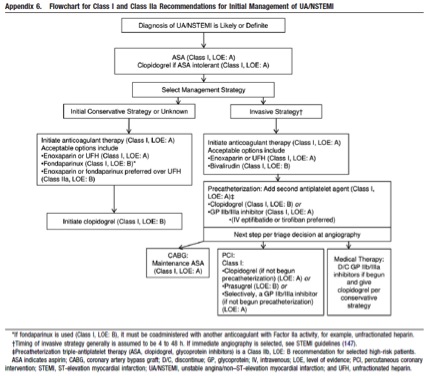
Much as for STEMIs, dual antiplatelet therapy with aspirin and a thienopyridine is recommended for NSTEMIs.  However, while the aspirin is to be administered immediately, the timing of the thienopyridine can be delayed until “as soon as possible after admission” for those patients being treated with medical management, according to the 2011 guidelines.  For those undergoing an early invasive strategy, it should be administered before (or at the latest, during) PCI.   Clopidogrel is the thienopyridine recommended in most circumstances, with the guideline updates allowing for prasugrel to be given only during (and not prior to) PCI for those NSTEMIs being treated with an invasive strategy. The reason for this was prasugrel’s high risk of bleeding, as discussed above. Ticagrelor will likely soon play a role in NSTEMI management as well, now that it has been FDA approved.

The 2011 guidelines brought about a change in recommendations regarding GP IIa/IIIb inhibitors in NSTEMIs.  Again, as with STEMIs, few trials exist examining GPIs in the setting of dual anti-platelet therapy.   Two trials that have examined GPIs in the setting of aspirin/clopidogrel compared early and delayed administration of  GPIs in UA/NSTEMI patients scheduled for PCI (EARLY ACS, ACUITY).  Neither found a significant difference in their primary end points (all-cause mortality, MI, recurrent ischemia), but both noted significantly greater risk of major hemorrhage in the early GPI patients than the later GPI patients.  These results were confirmed by a meta-analysis of studies evaluating early and delayed GPI use (De Luca, 2011). It is important to note, however, that these studies were done in moderate and high-risk patients scheduled for early invasive therapy, and hence their results may not apply to those UA/NSTEMI patients being treated with medical management.  Nonetheless, the ACC/AHA guidelines recommend that the use of a GPI as part of triple anti-platelet therapy should only be undertaken when the risk-benefit ratio suggest a potential benefit for the ACS patient who is undergoing PCI. The guidelines do not recommend GPIs  for patients being treated with medical management.

Anticoagulation regimens for NSTEMI vary, depending on whether a medical management or early invasive strategy is being taken, and on the patient’s bleeding risk.  If the patient is being treated with medical management, or the decision has not yet been made to pursue invasive interventions, then either enoxaparin or fondaparinux is recommended over UFH, in part for the reasons given above for STEMI. In addition, a Cochrane review of UFH versus placebo in ACS found no difference in mortality.  While it did find a lower incidence in non-fatal MI in the first week after the initial ACS event, the benefit was no longer seen at thirty days, three, and six months (Magee, 2008).   Enoxaparin has been found to be non-inferior, and likely superior, to UFH in preventing in-hospital death or MI  (ACUTE IIA to Z trial).

For patients undergoing early invasive therapy, UFH, enoxaparin or bivalirudin are acceptable agents.  Of note, unlike in medical management of NSTEMI,  at least one study (SYNERGY) has shown that in patients undergoing PCI, enoxaparin has a higher rate of bleeding than UFH, with similar rate of death or MI.  Bivalirudin was found to be non-inferior to heparin/LMWH combined with a GPI, (especially when clopidogrel was given early versus after PCI), and had a significantly lower bleeding rate. Hence, it is considered a good option in NSTEMI patients undergoing PCI at high risk for bleeding complications (ACUITY).

Below is a flow chart summarizing the 2011 ACC/AHA guidelines for management of UA/NSTEMI:

Posted in Uncategorized | Tagged | Leave a comment

RSI Episode 2: Induction, Questions

Coming soon: the finale to our August 2011 magnum opus on ACS!

September 2011

1. What are the optimal characteristics for an induction agent for RSI?

2. What are the pros and cons for the following induction agents: etomidate, ketamine, propofol, midazolam?

3. Do you use etomidate for patients in septic shock? What do you make of the evidence for and against?

4. What agent (and dose) would you choose for each of the following patients:

  • 18 yo male MVC w/ head trauma, GCS 6 (100kg), Vitals: 125/70,   80, 100% on NRB
  • 45 yo female w/ status asthmaticus (80kg), Vitals: 95/55, 125, 92%
  • 63 yo male w/ PNA (80kg), Vitals: 70/40, 144, 93% on NRB
  • 47 yo male w/ EtOH withdrawal s/p Valium 350 mg over 2 hours (75kg), Vitals: 165/95, 137, 98% on NRB

RSI 2 Questions Poster


Posted in Uncategorized | Tagged , | Leave a comment